Bringing Solar Grazing to Mon Power Site
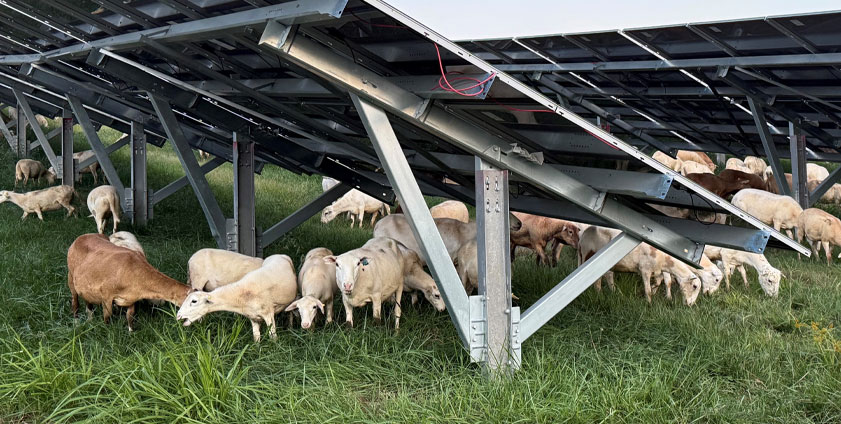
This year, approximately 350 sheep grazed at our Fort Martin solar site through the fall helping Mon Power maintain vegetation around 50,000 solar panels.
November 24, 2025
In a novel blend of agriculture and renewable energy, hundreds of sheep were recruited by Mon Power to maintain vegetation this fall around 50,000 solar panels adjacent to our Fort Martin Power Station. Mon Power’s use of the sheep for “solar grazing” is both eco-friendly and economically beneficial for West Virginia farmers. This method of natural lawnmowing is currently being used at 506 solar sites in 30 states, according to the American Solar Grazing Association.
“We’re managing this site with an innovative approach that blends renewable energy and agriculture for the benefit of our community,” said Dan Rossero, Vice President, West Virginia Generation. “Solar grazing allows us to keep the site operating efficiently while supporting local farmers and reducing our environmental footprint. By partnering with sheep farmers and advancing solar power, we’re making a positive impact that extends well beyond the fence line.”
|
Our West Virginia solar program The 18.9-megawatt Fort Martin solar site was the first of three sites developed as part of Mon Power and Potomac Edison’s solar program, which involves development of solar projects on brownfield or impacted industrial properties. With two additional sites in Marion County and Berkeley County, the companies have 30 megawatts of solar capacity. Through this program, Mon Power and Potomac Edison customers in West Virginia who support renewable energy can purchase solar renewable energy credits (SRECs) – certificates that represent the environmental attributes of solar power and prove solar energy was generated on the purchasers’ behalf. |
Nature’s natural lawnmowers
If a solar site’s vegetation grows too high, it can create shade that prevents the panels from generating energy. Sheep are naturally suited for the natural mowing task:
- They enjoy eating a variety of weeds and invasive species.
- They can graze underneath the solar panels, where it is more challenging to trim with mowers and weed eaters.
- They are sheltered from the rain and heat by the panels.
Local Sheep at Work
At the Fort Martin solar site, which went into service in early 2024, Mon Power has contracted with Sivic LLC, a solar grazing company headed by Nate Dean and Luci Mosesso, farmers based in Pocahontas County.
Approximately 350 sheep grazed at the site through the fall. Sivic moved the sheep around the property every four to six days, using temporary fencing to ensure that vegetation was trimmed consistently throughout the property. With the vegetation growth now slowing, the sheep will spend the winter at their farm in Pocahontas County and return to the solar site in the spring.
“It’s a regenerative way to manage vegetation on a site that’s already regenerative itself as a renewable energy source,” said Nate.